
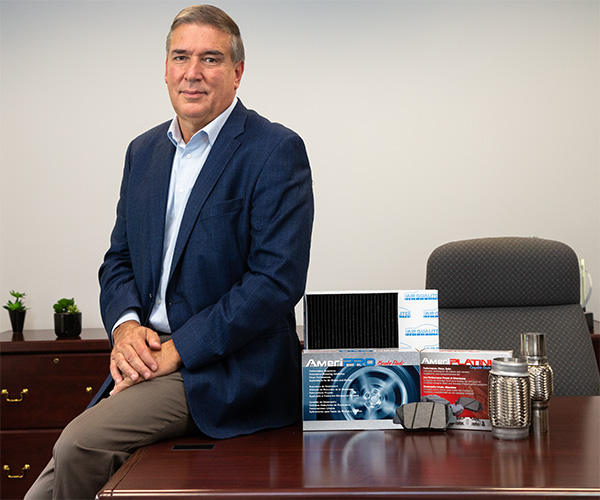
Momentum USA President John Paul Amalfe shares his perspective and contingency plans for his company in light of the looming tariffs and more
Richmond, Va.—One of the world’s most integrated trading relationships is exchanging trade blows and more may come as the U.S. and Canada is entering a potentially disruptive and consequential phase of their escalating tariff conflict.
Canada announced retaliatory tariffs of up to 50 percent on over 700 U.S. products, effective as of Sept. 8, in response to a U.S. announcement of new 50 percent tariffs on Canadian vehicles, steel and and other products. Automotive measures are to take effect Jan. 1, 2027.
The results are raised costs, disrupted supply chains and increased inventory uncertainty. In 2025, according to the Center for Automotive Research, the U.S. exported approximately $30 billion in auto parts to Canada and imported around $20 billion in Canadian auto parts.
John Paul Amalfe, president of Momentum USA, Inc., a family-owned, vertically integrated North American manufacturer with operations in both countries, spoke with Aftermarket Matters Weekly on his perspective and contingency plans for his company in light of the looming tariffs and more.
The conversation has been edited for length and clarity.
You manufacture brake friction in Canada. Are tariffs — and the threat of tariffs increasing to 50 percent — going to impact you?
They could, if you don’t plan ahead. We hope that both sides come to an agreement, honor the USMCA, continue to trade with each other in a respectful, good partnership — the way it’s been for years. But if it doesn’t happen and that 50 percent tariff was to go into place in January, we have contingency plans to make our friction products here in the United States.
We have equipment ready at our manufacturing facility in Richmond, Virginia, so we can meet our needs for the U.S. market, if necessary. We’ve been building that plan for almost 12 months now. There could be a trade war, but it’s not our job to guess whether it’s going to happen or not. It’s our job to make sure we’ve got Plan B to navigate through it if it happens. For us, it’s about having options.
Is that an additional facility to your location in Richmond?
No, we’ll add it to our current facility. We are already doing a lot of brake packaging there, so it’s just adding the primary sections of that, which our leadership has made sure we’re ready for.
Hopefully, we can continue to manufacture in Canada and service the Canadian aftermarket as a manufacturer in Canada. Our product is well entrenched there — 100 percent of our brake program is made right in Cambridge, Ontario.
People like the fact that it’s made in Canada and we ship it to distributors in Canada, so they like supporting a factory that actually makes the product there and is not importing it, either from the U.S. or anywhere else.
We’ve been building brakes in Cambridge since 2004 when we acquired Max Power Friction, serving both the U.S. and Canadian markets, along with export, OES and private label.
Beyond relations between the U.S. and Canada, what’s your perspective on global trade and today’s challenges?
The global aftermarket today is best described as very volatile. We just have to be ready for where it goes and what happens. For companies that rely on the global marketplace, it’s a very difficult place to be now when you’re an importer of offshore product — that’s why we manufacture in North America and get product to our customers quickly and service them on a weekly basis where need be.
Was COVID-19 a dry run for the challenges global networks have been, and are, facing today?
In 2004-2005, we were sold on making product in the United States because we didn’t believe the global supply chain would be sustainable. We assumed it was going to be cyclical and, at some point, offshore manufacturing would be challenged in some form or fashion.
COVID was the wake-up call for every purchaser in the supply chain. They had been purchasing for years and years globally, and everything was rolling good: containers were reasonably priced and delivered on time, they could turn inventory and everything was nice. Until COVID came. And since then, new challenges have come.
In your 40 years in this business, has there been a similar span of time where it’s been disruptive like this, or is this just a totally new game that we’re seeing right now?
Yeah, it really is a totally new game. There’s not been four consecutive years like it. But the aftermarket is very vibrant right now with organic growth: more vehicles in operation, vehicles are older, odometers are higher and more cars are out of warranty. And the numbers suggest those will continue for the next three to five years. We should all be getting the most expensive cigar, saying, “Hey, this is great.”
Unfortunately, it’s all the other stuff in the past four years that the industry doesn’t control, that it’s having to work hard at having strategies for. Some companies are successfully doing that. Other companies are not. We think we have a successful model.
What role does inflation, and risk of it escalating, play for the automotive aftermarket?
The concern is if inflation continues to hit the consumer who drives the out of warranty car that’s nine years old — and paying high gas prices — and how it affects their disposable income.
If those things continue to happen for an additional length of time, that consumer is going to create a settling down of our industry, and we won’t see the growth that we’re expecting. Because we’re driven by a healthy consumer. And right now, miraculously, they still seem to be pretty healthy.
But if this inflationary trend continues, they won’t do the repairs if they don’t have to do. And we saw that years ago (Great Recession, 2007-09), where a consumer would come into a shop, and they would need three credit cards to pay for the bill, because they were maxed out on two of them.
I hope we’re not heading back to that type of recession, because that’s a tough place for the automotive aftermarket, especially when we’re sitting with a vehicle on the operation table that we should be hitting it out of the park on.
If that happens, it’s going to offset the good times the aftermarket expects. We should all be smoking nice cigars. But I think we’ve built the toolbox for long term success.



Comments are closed.