
A new analysis of federal workforce data shows growing crisis even as Gen Z enrollment in skilled careers climbs for a third straight year
Scottsdale, Ariz.—The U.S. economy is short roughly 140,000 skilled technicians a year, and the gap is widening, according to a new analysis by the TechForce Foundation, which has tracked supply and demand in the U.S. technician workforce using federal data.
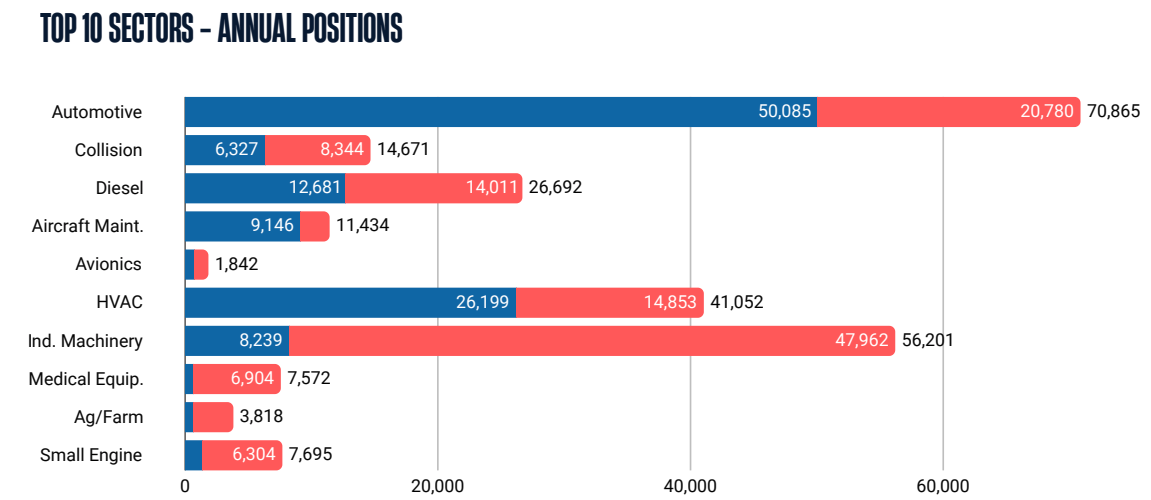
Across those 10 sectors, employers will need 241,842 new technicians a year through 2029 against 101,743 students who graduated from technical schools and community colleges last year, states TechForce’s latest annual report, Supply, Demand & Opportunity.
The cumulative five-year shortfall reaches 1.2 million workers. Lost wage output to the U.S. economy runs $7.42 billion a year, and $37 billion across the projection window.
“The pendulum has swung in America,” said Jennifer Maher, Chief Executive Officer of TechForce Foundation. “Society now recognizes four-year universities aren’t the only road to success.”
Above the median
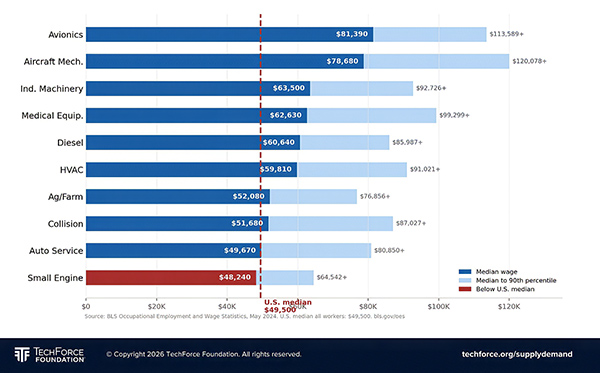
Nine of the 10 sectors in the report pay at or above the national median wage of $49,500, according to Bureau of Labor Statistics data. Avionics technicians, who repair the electronic systems aboard aircraft, earn a median of $81,390 with top earners exceeding $113,000. Aircraft mechanics earn $78,680 at median, with top earners crossing $120,000. Neither role requires a four-year degree.
Industrial-machinery mechanics, the workforce inside American manufacturing plants, earn $63,500. Diesel technicians, who keep the freight economy moving, earn $60,640. HVAC technicians earn $59,810. Collision-repair technicians, increasingly trained in materials science and the calibration of advanced driver-assistance sensors, earn $51,680.
Most of these careers can be reached through a one- or two-year certificate program. Across the 10 sectors covered, certificates account for 92 percent of completions. Six of the sectors produced zero bachelor’s degrees last year.
Four million on the sidelines
More than four million Americans aged 16 to 24 are neither in school nor working, according to data from the Annie E. Casey Foundation cited in the report. Disconnection is higher in rural counties than in urban or suburban areas.
Roughly 40 percent of recent high-school graduates do not enroll in college, the report notes, citing the National Center for Education Statistics. Of those who do enroll, 30 percent drop out within two years.
“There is no modern workforce-navigation system for skilled careers waiting for them,” the report states. “We tell young people ‘you can be anything you want’ but throw them to the wind to figure it out.”
A policy window
The report arrives at a moment of renewed federal interest in skilled trades. President Trump signed Executive Order 14278 in April 2025, titled “Preparing Americans for High-Paying Skilled Trade Jobs of the Future.” The order directed the Departments of Labor, Commerce and Education to consolidate and streamline federal workforce-development programs and to set a target of one million new active apprentices.
In January, the Labor Department issued guidance requiring all 50 states to submit modified workforce-development plans by spring 2026 under the Workforce Innovation and Opportunity Act. TechForce Foundation, which produces the longest-running longitudinal analysis of the U.S. technician workforce, has positioned its report as the data backbone those state plans will need.
The work that can’t be outsourced
Sector variance across the 10 industries is sharp. Aircraft maintenance, where Federal Aviation Administration certification has tightened the link between training and employment, fills 80 percent of its annual demand and is the only sector in the report approaching equilibrium. Medical equipment fills 9 percent. Industrial machinery fills 15 percent.
HVAC, the cooling backbone of every commercial building, hospital and AI data center in the United States, has 669 institutions training technicians but produces graduates to fill only 64 percent of annual demand. The Bureau of Labor Statistics projects the sector to grow much faster than average through 2034, classified as “much faster than average” in its Occupational Outlook Handbook.
The U.S. has 805,600 employed automotive technicians servicing a fleet at a record-high average age of 12.8 years, according to S&P Global Mobility data cited in the report. Auto repair generates more than $340 billion in North American revenue annually, according to Market Research Future. The sector produces roughly 42,000 graduates a year against 70,000 annual openings.
Where the graduates come from
Postsecondary completions in the 10 sectors grew 7.6 percent last year, the third consecutive year of growth. Eight of the ten sectors expanded; only avionics and agricultural-equipment programs declined.
Production is concentrated. Hallmark University, in San Antonio, Texas, alone produces 15.3 percent of all U.S. avionics-technician graduates. WyoTech, in Laramie, Wyoming, leads all U.S. institutions in diesel completions.
Reedley College, in California’s Central Valley, produces 22.5 percent of the country’s farm-equipment technicians. Six of the top 10 institutions training U.S. industrial-machinery mechanics are in Kentucky’s community-college system.
Download the full report here.









Comments are closed.