
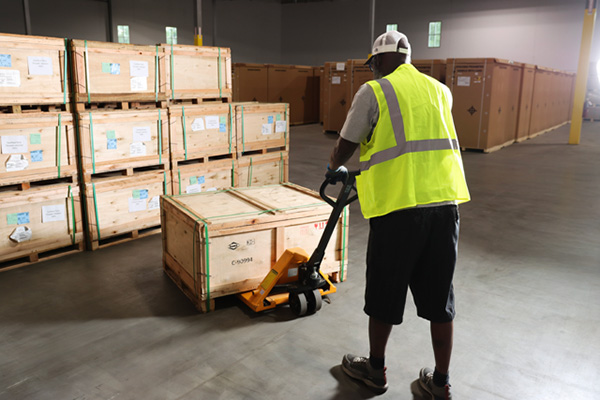
Distributors have reason to be optimistic for the likely increase in demand for parts but face significant transportation challenges in getting product to market
The average age of cars in America reached 12.8 years in 2026, according to S&P Global Mobility. Distributors have reason to be optimistic for the likely increase in demand for parts but face significant transportation challenges in getting product to the techs, shops, dealerships, and automobile owners who need them.

Tariff-related disruptions raise the likelihood of parts delays, threatening the service reliability and customer experience buyers depend on. As a result, the surge of aging cars in need of repair will only be a boon for distributors with a distribution machine that’s built for what’s coming.
Distributors need a network optimized for the future
Now is the time for distributors to strengthen supply chains. Amidst tariff-related volatility, maintaining stable costs and predictable service will be top priorities. By optimizing networks today, sellers can protect customer relationships and continue to deliver on time without destroying profit margins.
Distributors have options for mitigating the volatility and potential parts delays ahead. That’s the good news. The bad news is that their transportation networks might not have what it takes to take advantage of these opportunities.
What this means for shippers
There are significant forces working against each other, starting with sustained increases in parts demand driving higher shipment volumes, increased delivery frequency, and the ever-building pressure on same-day and next-day service models. Add to that, tariffs are now disrupting global trade and creating cost pressures.
The result for distributors will be margin compression and inbound variability where overseas parts deliveries are delayed. Another important consequence is that the inconsistency and inventory imbalances will force distributors to be more reactive and more reliant on expedited shipping.
This is a sector where the network and flow are challenging by nature and these forces will add to the pressure. So if companies are back on their heels and waiting to react instead of being proactive, they’re not going to be in good shape when demand spikes.
Transportation market forces add to pressures
Along with the drastically changing parts market, shippers must account for today’s dramatically changing transportation market.
A major shift is underway from the low rates and ample capacity shippers are used to. DAT reports that linehaul spot rates for dry van have risen 21% and the van-load-to-truck ratio has nearly doubled to 9.14 loads per truck since March 2025.
In a related move, carrier rejections have risen steadily throughout 2026. These forces combine to create a market where unreliable service and cost instability pose substantial new risks to shippers who rely on contract carriers or the spot market.
What should shippers do
Companies that get ahead of these forces by choosing correct carrier providers and staying nimble will fare the best. Now’s the time for distributors to strengthen carrier partnerships and avoid transactional relationships. In this market, shippers must strive for an integrated, committed capacity model that stabilizes capacity as well as relationships.
Stable capacity alone won’t protect brands’ service quality. Over the longer term, network design will determine success. Distributors must reengineer networks now to build flexibility in capacity to prepare for volume spikes. To enable agility in optimizations and in responding to disruptions, shippers must also prioritize investment in the latest visibility and planning tools.
These investments will provide enduring advantages as the parts market itself becomes more competitive. With the quality of overseas parts improving, speed and parts availability will increasingly become more important to buyers.
Strong carrier alignment and network design encapsulate the key strategies for distributors in the short and long term. Those are straightforward moves, but they’re easier said than done because they’ll cause many to take a hard look at legacy transportation models pieced together over time.
Piecemeal practices complicate carrier alignment
Service-sensitive and responsive transportation networks in parts distribution have traditionally been built piecemeal. They often rely on shared and contract trucking services that expose them to risk. That is especially true now. Today’s higher rejection rates create more spot exposure leading to service inconsistencies and unhappy customers.
Sellers with their own trucks will be sheltered from today’s rate and tender rejection uncertainties. However, scaling to quickly meet demand spikes will still force companies with inhouse fleets to augment capacity by outsourcing.This will only add the risk of unpredictable costs and inconsistent service back to their networks.
Inconsistency is going to be a networkwide challenge for all shippers at a time when they need dependable service as they scale. The search for stability is driving more interest in dedicated fleets from shippers seeking consistent service, guaranteed capacity and steady rates. Another advantage of dedicated fleets is that drivers create relationships with the dealers and retail locations and become an extension of their brands. This is a unique difference between dedicated and transactional models.
Dedicated fleets also provide an advantage when it comes to meeting demand. Drivers and assets can be sourced from the fleet’s wider pool and quickly integrated into established networks through existing training programs.
Dedicated fleet integration provides a crucial counterpoint to upstream disruption today. Greater integration of piecemeal networks amplifies service standards, continuous improvements and efficiencies networkwide.
With the right integrated network model, the opportunity to make up for delays, improve efficiency and mitigate tariff-related costs is there. According to Bain & Company, companies with inefficient distribution and transportation networks can typically lower their distribution and transportation network costs up to 25% by upgrading systems.
This is precisely why carrier alignment and network design need to be the tandem focus for the short- and long-term.
Long-term resilience requires tight network design
Transportation practices in parts distribution are primarily dictated by speed and coverage. As a result, many transportation networks weren’t engineered so much as they evolved. Networks created for delivering around time-definite windows, meeting a wide variety of constraints, and running sporadic reverse logistics present prime opportunities for optimization through supply chain engineering (SCE).
SCE holds the keys for reducing empty miles, poor route density, unpredictable dwell times, inefficient loading or unloading practices, and excessive expedited or recovery shipments. With a tight network design, SCE is applied consistently to continuously improve issues like these and to address root causes like constraints or the alignment of service expectations and pricing.
Reverse logistics in particular have unrealized potential for SCE. Within a responsive and coordinated transportation network, warranty and core shipments can be optimized to raise service standards and utilization.
Service performance and utilization are prime targets for optimizing reliability while reducing waste. Examples of successful application of SCE include one parts distributor that increased their struggling on-time percentage to 99% networkwide through monthly routing analysis. Another company avoided a $500,000/year increase in payroll and hiring costs by optimizing utilization. These are exactly the capabilities that parts distributors need today.
Those with networks engineered to nimbly meet the demands of speed and coverage as well as efficiency will be in a much better position to meet demand while absorbing and mitigating disruption going forward.
With the right technology-enabled transportation network, parts distributors will meet demand without breaking service and damaging their brand.
Melissa Suedbeck is Vice President of Operations at TA Dedicated, where she brings 15 years of experience leading transportation operations. She is known for building strong customer partnerships, developing high-performing teams, and delivering practical, results-driven solutions in complex environments. In 2025, Melissa was named a “Top Women to Watch in Trucking” by the Women in Trucking organization. Later that year, she was recognized by Commercial Carrier Journal as a Supply Chain Innovator for outstanding Safety program deployment. She is a graduate of the University of Wisconsin (Eau Claire) where she studied Business Administration and Psychology.








Comments are closed.