
The 33 percent rise reflects increases in car repair parts and labor with labor costs rising 51 percent and parts 23 percent
Irvine, Calif.—The 2026 CarMD Vehicle Health Index report shows that the average cost to address a check engine light climbed to a record $554 in 2025, a 33% increase from the previous year.
The rise reflects increases in car repair parts and labor. Labor costs grew 51%, driven by more time-intensive procedures and increasingly complex systems, while parts costs rose 23%, influenced by material pricing, multi-component repairs, and, in some cases, tariffs of imported components being passed on to consumers.
These factors, combined with the aging U.S. vehicle fleet, contributed to the highest repair costs recorded since CarMD began publishing its annual study of check engine repair trends.
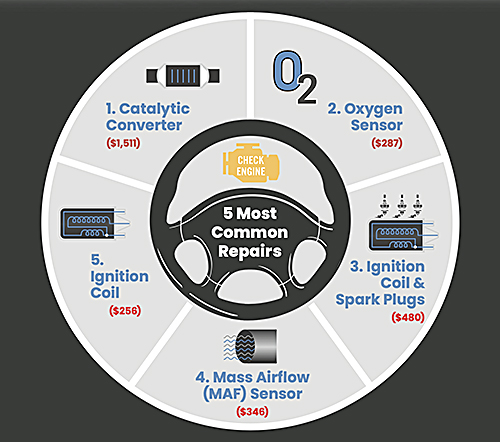
10 Most Common Dashboard Warning Light Repairs in 2025
1. Catalytic Converter, $1,511
• SYMPTOMS: Sluggish performance, dark exhaust, heat under vehicle.
• CAUSE: Usually won’t fail unless triggered by unresolved misfires or failed O2 sensors, or vehicle age.
• WHY IT MATTERS: Most expensive preventable repair, but more common as drivers keep their cars longer.
2. Oxygen (O₂) Sensor, $287
• SYMPTOMS: Poor fuel economy, rough idle, often few symptoms aside from the check engine light
• CAUSE: Age, lack of maintenance, clogged air filters
• WHY IT MATTERS: Many drivers ignore the O2 sensor because it seems like the vehicle is driving fine, but ignoring it accelerates catalytic converter failure and reduces fuel economy by as much as 40%.
3. Ignition Coil & Spark Plug(s), $480
• SYMPTOMS: Poor acceleration, loss of power, poor fuel economy, engine misfires, trouble starting.
• CAUSE: Worn plugs stressing coils; example of how ignoring a smaller problem like a spark plug can snowball into the need for more than one part, adding ignition coil-related costs to the repair bill.
• WHY IT MATTERS: Leads to costly emissions failures if ignored.
4. Mass Air Flow (MAF) Sensor Replacement, $346
• SYMPTOMS: Stalling, hesitation, poor MPG.
• CAUSE: Contamination or aging.
• WHY IT MATTERS: Affects performance and fuel efficiency.
5. Ignition Coil, $256
• SYMPTOMS: Rough idle, hard starts, misfires
• CAUSE: Excessive heat, aging, worn spark plugs make coil work harder, oil leaks
• WHY IT MATTERS: Can damage catalytic con
6. EVAP Canister Purge Control Valve, $172.
• SYMPTOMS: Rough idle, reduced fuel economy, hard starts.
• CAUSE: Faulty valve, corroded connectors, or purge flow outside expected range.
• WHY IT MATTERS: EVAP issues share symptoms with many other problems — proper diagnosis is important to avoid unnecessary parts replacement.
7. Fuel Injector(s), $572
• SYMPTOMS: Misfires, poor idling, reduced fuel economy, performance issues.
• CAUSE: Wear, clogging, or electrical failure in one or more injectors.
• WHY IT MATTERS: Failures can affect combustion balance and lead to drivability issues or catalytic converter stress.
8. ABS Wheel Speed Sensor, $314
• SYMPTOMS: ABS and/or traction control lights, loss of ABS function, wheel lockup during hard braking, low speed brake pulsation.
• CAUSE: Sensor degradation, wiring faults, or debris interference.
• WHY IT MATTERS: Affects stability control, braking behavior, and can disable connected systems such as cruise control
9. Thermostat, $324
• SYMPTOMS: Failure to reach operating temperature, engine overheating.
• CAUSE: Thermostat stuck open, rust, lack of coolant changes, or exposure to extreme temperatures.
• WHY IT MATTERS: Incorrect coolant temperature affects performance, fuel economy, and emissions — and can cause secondary engine issues.
10. Spark Plug(s), $299
• SYMPTOMS: Misfires, reduced performance, poor cold starts, increased fuel use.
• CAUSE: Normal wear from age, heat, and combustion cycles.
• WHY IT MATTERS: Often replaced together with ignition coils; worn plugs can trigger misfires that lead to more expensive ignition and emissions repairs.
Many of these issues are interconnected; for example, unresolved misfires or faulty oxygen sensors can eventually damage the catalytic converter — one of the most expensive components to replace. And ignoring a failing oxygen sensor can negatively impact a car’s fuel economy by as much as 40 percent.
Safety-Related Warning Lights Are Becoming More Common
This year’s index shows a noticeable rise in diagnosis of dashboard alerts tied to safety systems. The ABS wheel speed sensor appears in the national Top 10 list for the first time, indicating more diagnosis of issues connected to braking and traction-control systems. TPMS (tire pressure) sensors also remain among the most frequent repairs, reinforcing the importance of proper tire-pressure monitoring.
Aging Fleet Is a Key Driver of Repair Severity
The average vehicle age in the U.S. reached 12.8 years, an all-time high that continues to shape car repair trends. As vehicles accumulate mileage, components such as ignition coils, spark plugs, oxygen sensors, thermostats and mass air flow sensors naturally wear out, triggering more dashboard warning lights and a greater likelihood of multi-part repairs when maintenance is postponed.
Special Feature: Van Life Repair Trends
New in this year’s Index is CarMD’s first national review of repair trends for van life platforms — the Mercedes Sprinter, Ram ProMaster and Ford Transit.
The analysis shows these Class B RVs experience elevated stress due to long-distance travel, heavy builds, higher loads and exposure to wide temperature changes, which leads to more frequent and expensive repairs compared with typical passenger vehicles.
The report also highlights repair patterns for each platform — including more turbo and diesel issues, and higher transmission failures — and breaks down differences in failure types by platform.




Comments are closed.