
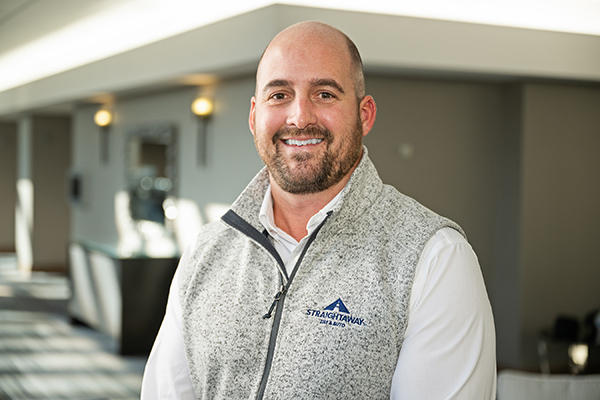
Straightaway’s five founding partner brands have each more than doubled since 2023 and they share their formula for success in expanding to six regions
Charlotte, N.C.—Straightaway, a national automotive repair platform, announced this week it has surpassed 100 shops, growing from 43 shops and five founding brands at its formation in April 2023 to a network spanning six regions.
“What we’re building is a local brand with real scale underneath it — the same shop people already trust to fix anything, but with a location a minute from wherever they are and a name the entire market knows,” said John Teddy, CEO of Straightaway. “There’s no shortcut to that. You have to start with a name the market already believes in and then make it much bigger.”
How the Model Works
Straightaway enters a market by partnering with a particular kind of local operator: someone running multiple shops who has built a real culture of operational excellence, developed a team capable of carrying it forward, and wants to keep growing rather than walk away. That operator’s name, leadership, and team stay in place, and their brand becomes the market’s flagship.
Every shop Straightaway adds in that region afterward, including the single-shop businesses it acquires, takes on the flagship name, extending a brand customers have known for decades across the rest of the metro.
Straightaway operates no consumer brand of its own. In every market, the name customers see is the flagship: a local brand built by a local operator, not a national banner.
Straightaway was formed in April 2023 through the simultaneous partnership of five local brands operating 43 shops between them, each with decades of standing in its market. Each has since more than doubled in size, and everyone is still led by the family that built it.
Growth of that scale changes the shape of a brand’s organization. Administrative functions that every brand was duplicating on its own. Accounting, payroll, reporting, and IT move to shared support teams, and Straightaway reinvests in roles the shops rarely had the scale to justify before, including dedicated recruiters, marketing support, and field leadership.
The expansion has also created new leadership positions that have been filled by promoting from within.
“I started Straightaway alongside four partners I’d known in this industry for years, so I’ve watched this from the inside from day one,” said Brian Bates, Chief Operating Officer and a founding partner of Straightaway. “I won’t tell an owner that nothing changes, because that isn’t true and they wouldn’t believe it.
“Work that never grew anybody’s business moves off the brand, and what goes back in are people the shops actually needed. Someone whose whole job is recruiting technicians, someone running marketing properly.”
Bates continued, “Our brands are more than twice their size, and the people running those shops in 2023 have bigger jobs today because there’s more business to manage. The same is true for me. I spend my time now on the things I got into this business for in the first place — growth, our people, and operational excellence — instead of the work that used to eat my week.”
The company’s newest partnership shows how much faster that process has become. Silverlake Automotive joined in early 2026 as Straightaway’s Pacific Northwest flagship, and the hundredth shop was Silverlake’s second acquisition in Spokane, a pace the founding brands took considerably longer to reach.
“We partnered at the start of this year, and we’re already acquiring,” said Will Sando, Brand President of Silverlake Automotive. “The support has been tremendous — recruiting, marketing, a team doing the deal work, and none of it changed how we run our shops.
“What the original brands spent years helping build was ready and waiting for us on day one. We’re aiming to double the size of this business by the end of the year.”
Density Is How a Brand Becomes the Market Leader
Straightaway grows each flagship through single-shop acquisitions in the surrounding market, converting them to the flagship name and fully renovating them physically and experientially. A shop that served one neighborhood under its own sign becomes part of a brand the whole metro has known for 30 years, in a network dense enough that a location is a short drive from most of it.
“Being nearby isn’t a detail of the strategy, it’s the strategy,” Teddy said. “Every shop we add shortens someone’s drive and adds capacity in a market where people already know the name. That compounds in a way that a flag in a new state does not.”
The company has accelerated its acquisition pace in each successive year since inception, adding more shops in 2026 to date than in any prior full year — a trend it expects to continue as new markets come online.
That concentration shows brand by brand. Victory Tire & Auto operates 30 shops in and around Minneapolis–St. Paul; EAS Tire & Auto, 25 in greater Denver; Auto Care Plus, 20 across southern Maine, New Hampshire, and northern Massachusetts; All County Automotive, 17 in South Florida; and Silverlake Automotive, seven in greater Spokane and Coeur d’Alene.
One shop operates in Charlotte, the company’s headquarters market, and its newest region. Village Autoworks, one of the founding brands, has been consolidated into Victory Tire & Auto so that the Twin Cities operate under a single name.
Scale Earns the Right to Market Like a Brand
The first three years of work were foundational: partnering with the right operators, consolidating each market under a single flagship name, and building the supporting platform. Those brands have now reached a size in their markets where they can be marketed as brands rather than as individual shops — an inflection point the company describes as the beginning of its next phase.
In Colorado, where 20 of EAS Tire & Auto’s 25 shops now carry the flagship name, Straightaway launched its first brand marketing campaign this summer. “Colorado Roads Hit Different” runs through the end of the year across billboards, gas station displays, radio, and digital and social channels, alongside local community sponsorships, including the Teddy Bear Patrol.
It is the company’s first significant investment above the funnel, and the template for what follows: a national campaign spanning all of Straightaway’s brands, unified in message and local expression.
“You can’t run a campaign like this with four shops in a metro; the math doesn’t work,” said Cameron Chernikow, Chief Brand Officer. “Density is what earns you the right to speak to an entire market at once, instead of buying customers one click at a time.
“We’ve spent three years building brands big enough to carry a message, and now we get to put one behind them. What we say will be shared across our brands. How we say it stays local, because Colorado roads really do hit differently than New Hampshire’s.”
The company is making a parallel investment in customer retention and lifetime value, with more to be announced in the coming months.
“A lot of this category runs on churn: get the car in, maximize the ticket, hope they come back,” Teddy said. “We’re building the opposite of that. When we do this right, a customer’s vehicle lasts longer and costs less over its life, and that is real money staying in a household rather than going toward a car payment.
“A relationship like that isn’t something you hope for. It’s something you deliberately invest in before you need it. And we already know more about these vehicles than anyone else does — every inspection, every repair, every part we’ve put in — and almost none of that gets used in the relationship today.”
Teddy continued, “The technology work we have underway is about handing it back to the customer, so they know what their car needs before it becomes a problem. I think that changes what people expect from this category, and we’ll have more to say about it soon.”
Exceptional Experiences, Superior Results
Those investments run back to the mission Straightaway started with: empowering growth-minded local automotive repair brands to deliver exceptional customer experiences and superior financial results. The company stated it treats the first as the engine of the second — the quality of the experience is what produces the returns, not the other way around.
Customers currently rate Straightaway’s shops an average of 4.8 stars across roughly 56,000 reviews. As the company optimizes its brands from here, it is prioritizing investment in the other half of the problem, making them easy to deal with as they are capable.
That means keeping up with vehicles as they change and removing friction: more ways to book than a phone call, visibility into where a vehicle stands without having to ask, transportation options so a repair doesn’t rearrange someone’s day, flexible payment so cost isn’t the reason a needed repair waits, and loyalty solutions that reward people for coming back rather than discounts.
“We’re not really in the repair business,” Chernikow said. “Repair is what we do. Simplification is what we sell. Car care is exhausting mostly because people don’t know what the car needs, when it’ll be ready, or whether they’re being told the truth. Take the wondering out of it, and there’s no reason left to go anywhere else.”
Delivering that depends on technicians and advisors. Straightaway has built apprenticeship-to-master career paths, an in-house training academy, and recognition and equity participation programs for front-line team members.
It also runs a hardship assistance fund for team members facing an emergency, funded largely by the company’s vendor partners and by employees contributing to one another. Straightaway said treats it as a marquee program for a simple reason: whatever else the company builds, people sit at the center of it.
“One hundred shops was never the point,” Teddy said. “The point is what a hundred shops make possible. We spent three years building the brands, the teams, and the support behind them, and that was the hard part.
“What comes next is putting real weight behind names these communities already trust, alongside operators who want to build something that outlasts them. That’s a much bigger business than the one we have today. It’s the one we’re building.”



Comments are closed.