
A shift in claims trends is introducing new challenges for insurers and repairers related to risk exposure, cycle time and repair complexity
San Diego—Mitchell has released its Q1 2026 Plugged-In: EV Collision Insights report that reveals a shift in electric vehicle claim trends. The shift is introducing new challenges for insurers and repairers related to risk exposure, cycle time and repair complexity.
In Q1, the share of repairable collision claims for battery electric vehicles (BEVs) held steady at 3.33% in the U.S. At the same time, claims for mild hybrid electric vehicles (MHEVs) surged to record highs—5.69% in the U.S., representing year-over-year increases of 25%.
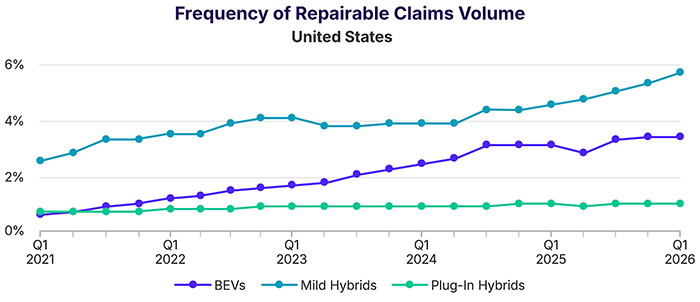
Source: Mitchell Q1 2026 Plugged-In: EV Collision Insights report
“Electrification isn’t slowing, it’s evolving,” said Ryan Mandell, Mitchell’s vice president of strategy and market intelligence. “Even as BEV sales soften, the number of hybrids on the road is growing, and that is clearly reflected in the rise of hybrid collision claims.
“For insurers, this affects the types of vehicles and risks they must manage. For repairers, it adds complexity by requiring additional tooling, labor operations and training to ensure a proper and safe repair.”
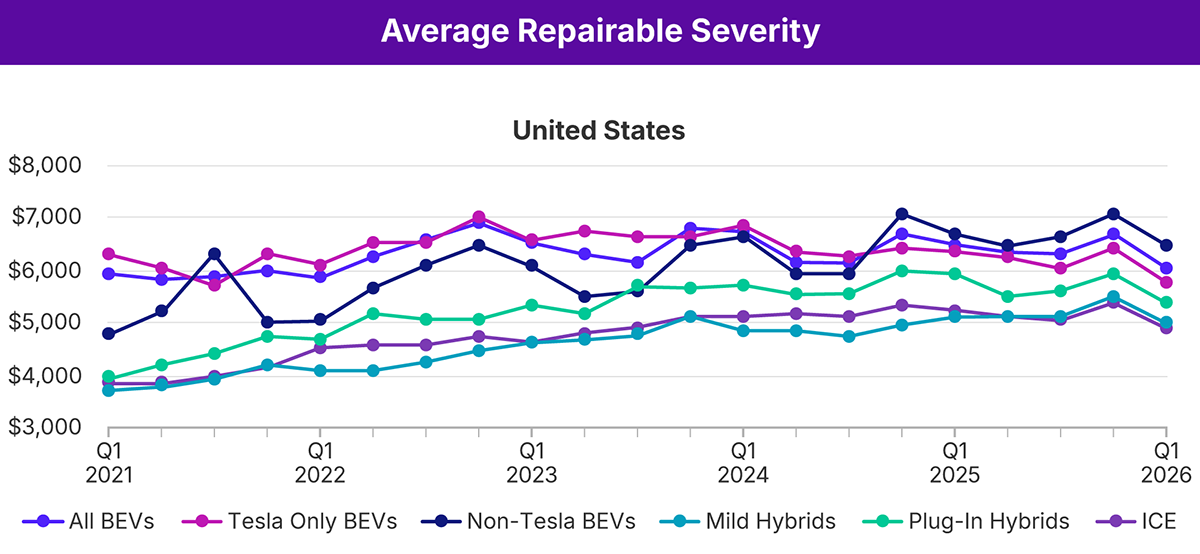
BEVs continue to generate the highest claims severity due to their advanced technology and complex, interconnected electronic systems. In Q1, average repairable severity in the U.S. was $6,042 for BEVs, compared to $5,352 for PHEVs, $4,993 for MHEVs and $4,902 for gasoline-powered automobiles.
Quarter-over-quarter severity declined across all powertrains, with reductions of approximately 9% in the U.S..
The Q1 2026 report points to increasing fuel costs and geopolitical instability in the Middle East as key drivers accelerating consumer interest in electric vehicles, primarily hybrids, while supply constraints, import tariffs and the expiration of federal tax incentives have slowed the BEV adoption rate.
Despite this near-term slowdown, BEVs are still expected to reach approximately 29% of new vehicle sales and just over 10% of vehicles in operation by 2035.
View the entire report here.



Comments are closed.