
The share of the state’s population that lives within a 10-minute round trip drive of a DC fast charging station has increased in the last two years
East Lansing, Mich.—Anderson Economic Group (AEG) has released the results of their recent analysis on the state of the electric vehicle charging infrastructure in Michigan, finding that the number of chargers continued to increase in 2025 and access has improved across the state.
There are currently 569 public DC fast charging stations and 1,721 Level 2 charging stations across
Michigan (as of July 7, 2026). Michigan has all three types of EV charging stations. The fastest are DC fast, which can charge an electric vehicle in about 30 minutes. Because of their speed, most EV charging infrastructure investment focuses on DC fast charging stations.
- Level 1: ~1 kW, 120 V AC (can take 2-plus days to charge a Battery Electric Vehicle (BEV) to 80%)
- Level 2: 719 kW, 208-240 V AC (can take 4-10 hours to charge a BEV to 80%)
- DC Fast: 50-350 kW, 400-1000 V DC (can take 20 minutes to 1 hour to charge a BEV to 80%, not compatible with Plug-in Hybrid Electric Vehicles)
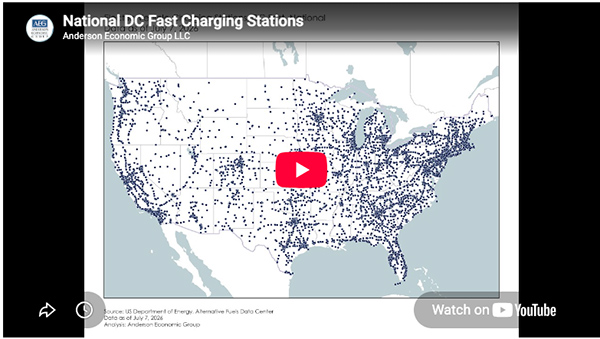
In 2025, the number of public DC fast charging stations increased by 125 (about 32%) over the prior year’s total of 389. An additional 55 became operational in early 2026. Michigan’s growth rate is on par with the nation overall, where the number of public DC fast charging stations increased 31% in 2025. There are currently 15,670 DC fast charging stations in the United States.
The firm’s experts analyzed the geographic distribution of existing charging stations. Among the findings:
- DC fast charging stations are concentrated in the lower half of the Lower Peninsula.
- DC fast charging stations are available mainly in the urban areas of Detroit, Ann Arbor, Lansing, Grand Rapids, and Kalamazoo.
- There are relatively few DC fast charging stations in the upper half of the Lower Peninsula, with some available in Traverse City and along major highways.
- There are only 21 DC fast charging stations in the Upper Peninsula. These are located in Marquette, Houghton, Hancock, Copper Harbor, Sault St. Marie, Brimley, Escanaba, Iron Mountain, and Norway.
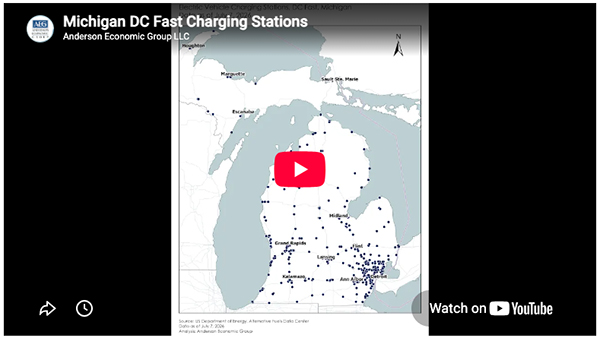
Comparison: Michigan vs. U.S. EV Charging Station Infrastructure
Based on charging station data to date, Michigan ranks sixth in the number of DC fast charges in the U.S. The top five states with the highest number of charging stations are California, Florida, Texas, New York, and Illinois.
However, when controlled for population, Michigan ranks 16th in the nation in the number of DC Fast chargers per capita. The top five states with the highest number of charging stations per capita include Vermont, Maine, Colorado, New Mexico, and Oregon.
Comparison: Fuel Retailer v. EV Charging Station Infrastructure
AEG also compared the number of charging stations to the availability of fuel retailers across the state. While most EV buyers charge at home, many without this ability or those traveling need to access public charging stations while in transit, just as they would need to refuel at a gas station in a car with an internal combustion engine.
AEG senior consultant Cristina Benton points out that “Michigan’s fuel retailer network took nearly a century to build to the level it’s at now, which is likely more than 4,700 stations.”
AEG Analyst Dieter Roeser said, “The share of Michigan’s population that lives within a 10-minute round trip drive of a DC fast charging station has increased in the last two years, from 19% in 2024 to about 32.2% now. There is still more work to be done, as more than 90% of Michigan’s residents live within a 10-minute round trip of a gas station.”
It is also worth examining the difference in site-selection strategies between DC fast charging stations and fuel retailers. DC fast charging stations appear to be concentrated primarily in densely populated areas, with strategic outliers distributed along major interstate corridors.
Fuel retailers exhibit a similar pattern to some extent; however, they also tend to locate near suburban and rural communities. In low population areas, fuel retailers may be able to sustain operations through the sale of convenience goods in addition to fuel.
Sales of electric vehicles dropped in the U.S. after the $7,500 federal EV tax credit ended in September 2025. Battery electric vehicles typically have higher prices than other fuel-type vehicles. However, consumers continue to purchase electric vehicles and about 5% of new vehicle sales were comprised of electric vehicles in the first half of 2026.
“Availability of EV charging stations continues to affect demand for electric vehicles, so the expansion in changing stations coming online across Michigan and the U.S. is helpful to consumers looking into electric vehicles,” said Dr. Cristina Benton, AEG’s Director of Market & Industry Analysis.
The analysis uses data from the U.S. Department of Energy Alternative Fuels Data Center as of July 7, 2026, and the Michigan Department of Agriculture and Rural Development as of July 10, 2026.







Comments are closed.