
Before the January price letter goes out, look up your top part numbers where your shops look them up. Then decide SKU by SKU.
The 2027 price letters are being written right now, and there’s good reason to expect more of them. In May, the New York Fed’s regional business surveys asked firms that had paid tariffs directly whether they were done raising prices.

Forty-four percent of manufacturers said they still had tariff-induced increases to come, and 7 percent were planning them more than six months out. Some of that lands on your shelves in January.
Your shops won’t read the letter the way you wrote it. They read it one part number at a time, usually with a phone in hand. Say a pad set sat 8 percent under the online price last quarter. After your increase it sits 3 percent over, and the shop notices before your sales rep does.
Here’s a way to pass through what you have to, hold what you should, and keep the accounts that make your year.
A flat increase treats every part the same. Your shops don’t.
Ben Groeneveld made the case on this site in October, writing for suppliers: “The days of passing along the same increase across an entire catalog and assuming customers will accept it are gone.” One step down the chain, at the distributor counter, it’s even truer, because the alternative is one search away.
Shops already look. Roland Berger’s Automotive Aftermarket Pulse 2025, built on surveys of 600 workshops and 6,000 consumers across 13 markets, found that “more than 60% of workshops in mature markets now source significant volumes online, and further growth is expected.” Aftermarket Matters covered the same study in March.
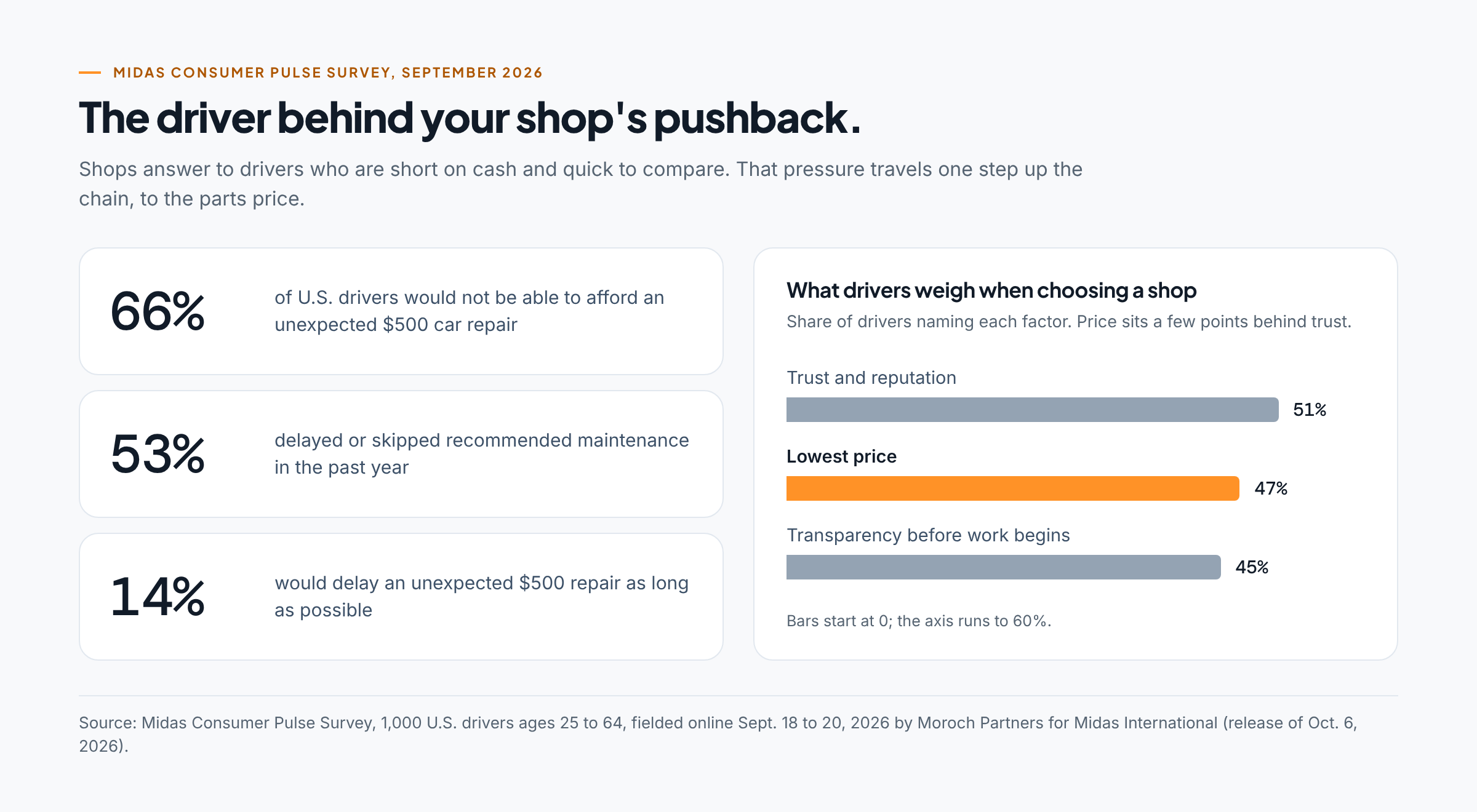
The pressure behind the counter is real too. In the Midas Consumer Pulse Survey of 1,000 U.S. drivers this fall, 66 percent said they would not be able to afford an unexpected $500 repair, 53 percent had delayed or skipped recommended maintenance in the past year, and lowest price (47 percent) was the second most-cited factor in choosing a shop, just behind trust and reputation (51 percent). Aftermarket Matters reported the findings in October.
A shop living with that customer has every reason to push back on a parts price it can beat online.
Step 1: Look up your top SKUs where your shops look them up
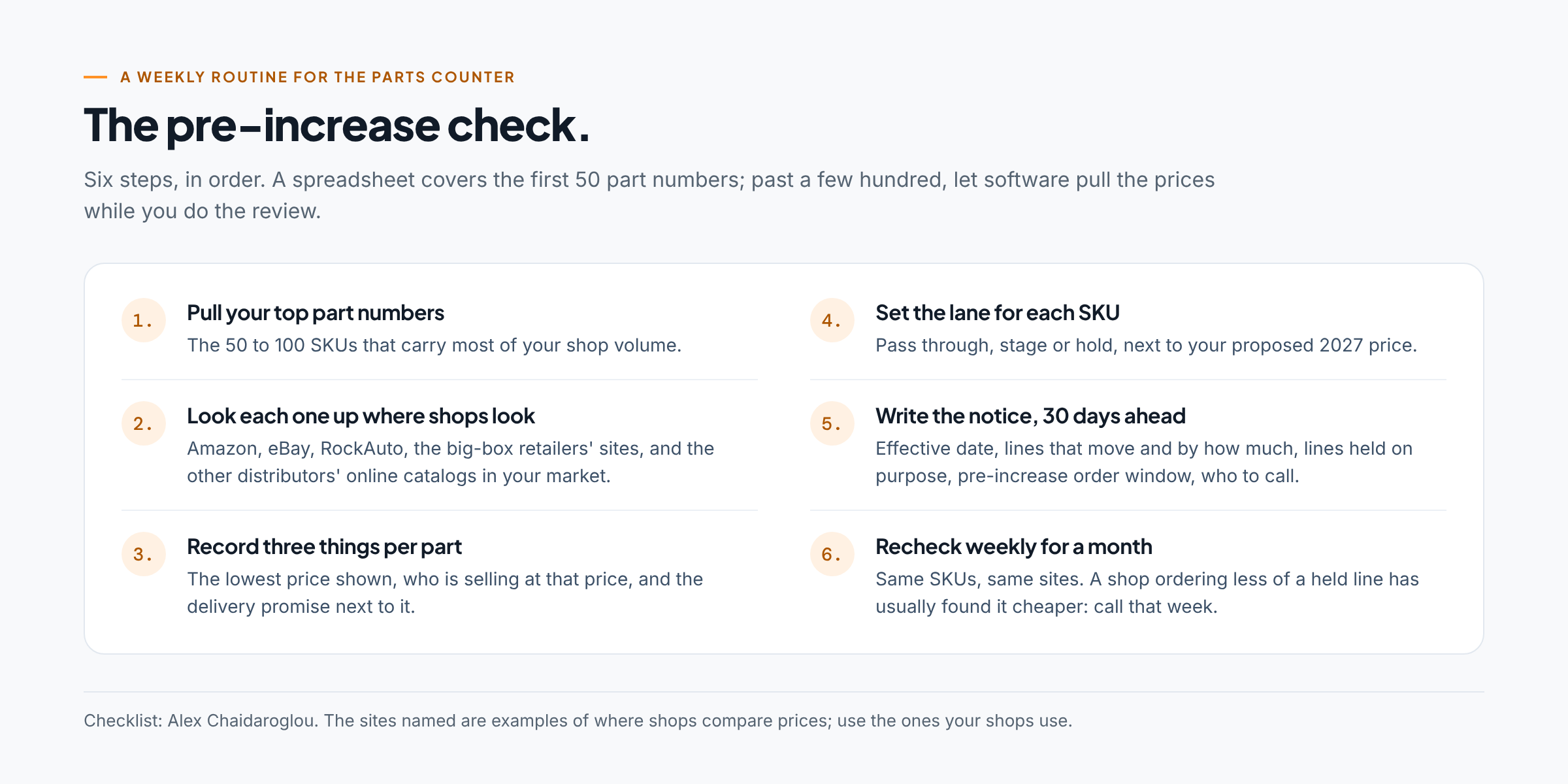
Pull the 50 to 100 part numbers that make up most of your shop volume. Then check each one where a shop would: Amazon, eBay, RockAuto, the big-box retailers’ sites, and the online catalogs of the other distributors in your market.
For each part, write down three things: the lowest price shown, who is selling at that price, and the delivery promise next to it. A warehouse 900 miles away quoting four days is not the same competitor as the store across town.
A spreadsheet handles 50 SKUs. Past a few hundred, this becomes a job for software: a daily automated price check can pull those prices for every part number you carry, so your pricing review turns into a 20-minute read instead of a day of lookups.
Step 2: Put every SKU in one of three lanes
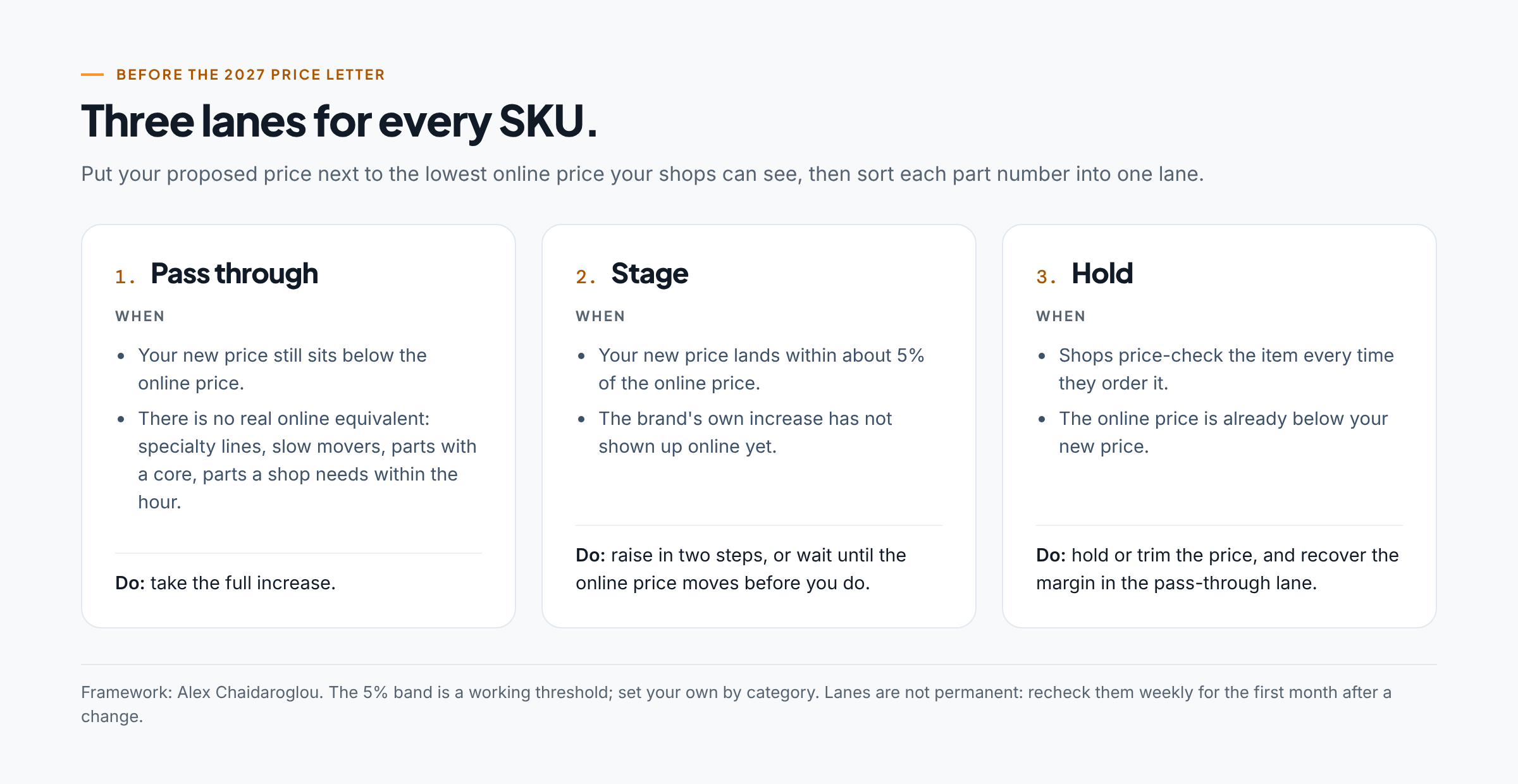
With the online prices sitting next to your proposed 2027 prices, each SKU falls into a lane.
- Pass through. Your new price still sits below the online price, or there’s no real online equivalent: specialty lines, slow movers, parts with a core, parts a shop needs within the hour. Groeneveld’s point holds here: a specialist component with few alternatives has room. Take the full increase.
- Stage. Your new price lands within about 5 percent of the online price. Raise in two steps, or wait until the brand’s own increase shows up online before you move, so your shops don’t see you as the only one raising.
- Hold. The items your shops price-check every time, and anything already cheaper online than your new price. Hold the price or trim it, and recover the margin in the pass-through lane. As Groeneveld put it, “holding the price might actually deliver a better commercial result.”
The Midas numbers point at where to look first. The jobs drivers postpone when money is tight are oil changes (33 percent), tires (32 percent) and A/C repair (31 percent). Those are the jobs where a shop has time to shop the part. When the car is already on the lift with a dead battery, speed wins and price takes second place.
Step 3: Price the relationship, not just the part
A shop isn’t buying only a part from you. It’s buying the hot-shot delivery, the return that doesn’t turn into an argument, the warranty claim you handle, the core credit and the terms.
Roland Berger’s study found that for shops buying online, “price remains a key driver, but delivery reliability, flexible payment options, and strong support are emerging as decisive factors for success.” Those are your advantages, and they are worth money.
So a 4 percent gap on a filter rarely moves an account. A 15 percent gap on a battery the shop sees every week does, because it tells the shop to check everything else you sell. Hold the visible items, pass through the rest, and say so.
Remember who the increase lands on. Divya Manohar noted here on Nov. 1 that 87 percent of distributors that prioritize new customer growth track their new-business win rate, against 46 percent of those focused on expanding existing accounts. The shops you already have are where the increase lands. Treat it as an account conversation, not a letter.
Step 4: Tell the shop before the shop tells you
Send the notice at least 30 days ahead, and make it specific:
- The effective date, which lines move, and by how much.
- Which lines you’re holding, and that you’re holding them on purpose.
- Whether a pre-increase order is available on the lines that move, and until when.
- One named person to call about it.
A shop that hears “we held your brake and filter lines, and here’s why” reads the rest of the letter differently.
Then keep checking
The lanes aren’t permanent. Online prices move, and once the brand’s increase shows up on Amazon and eBay, a held SKU may be ready to move in March. Recheck your top SKUs weekly for the first month after the change. I described a weekly version of this check for small retailers in Specialty Retailer, and it works the same at a parts counter.
Watch one more signal. A shop whose order frequency drops on a held category has usually found it cheaper somewhere, and that’s a call to make this week, not next quarter.
Pass through the cost. Don’t pass through the shop.
About the author
Alex Chaidaroglou is the founder and CEO of Altosight, which tracks millions of prices daily so online retailers and brands can defend their margins: competitor monitoring, repricing with hard floors, and MAP enforcement, minus the manual grind. After 15+ years in pricing, e-commerce, and SaaS, he publishes practical pricing playbooks at altosight.com. LinkedIn: linkedin.com/in/alexchaidaroglou


Comments are closed.