
Honda consistently runs half the failure rate of a Chevrolet while German brands fail inspection 39 percent more often than Japanese cars
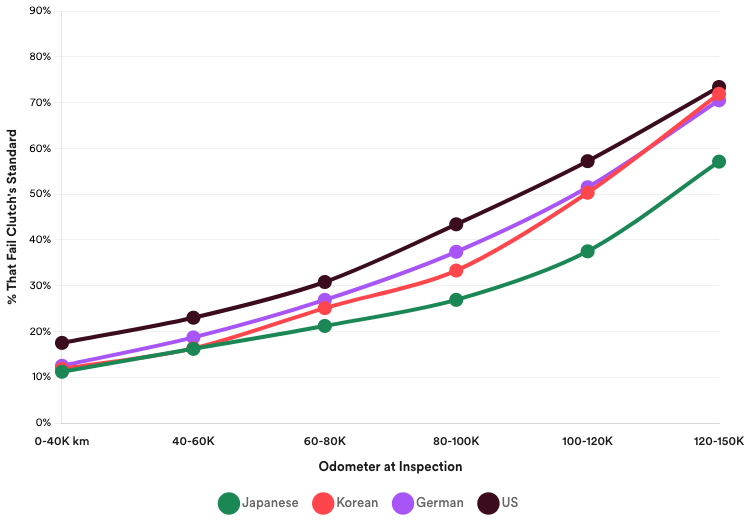
Toronto—A new report has found that despite their reputation, German brands such as BMW, Mercedes-Benz and Audi fail inspection 39 percent more often than Japanese brands once the vehicles reach the 62,000 mile mark.
Country of Origin: How Brands Age With Mileage
Source: Clutch Certified Reliability Report 2026
The average American car fails inspection 60 percent more often than Japanese cars. Korean cars fail by 24 percent. The study by online used vehicle retailer Clutch highlights that brand matters more than mileage alone.
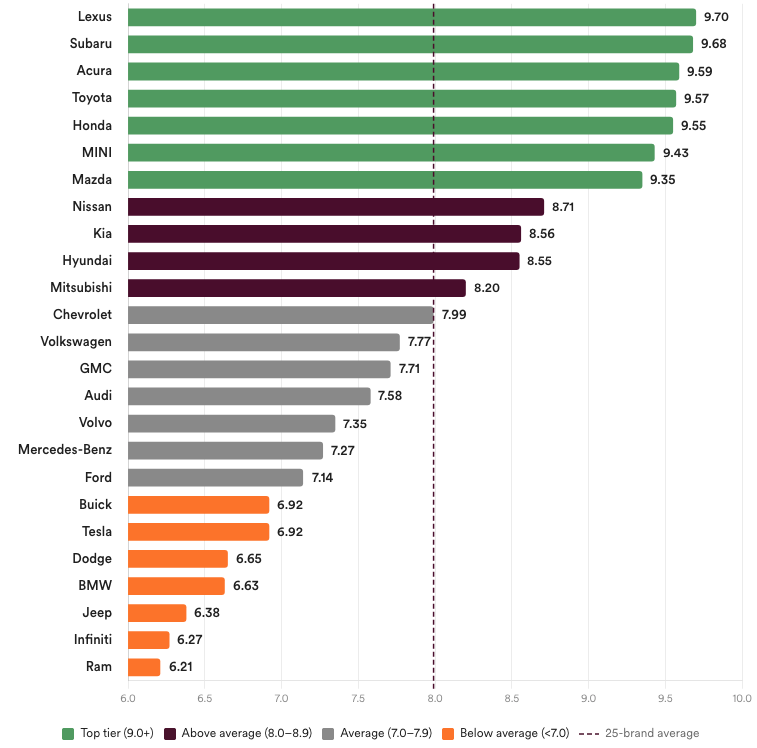
Reliability Index: 25 brands ranked across four reliability dimensions
Source: Clutch Certified Reliability Report 2026
Japanese brands sweep the top five makes for reliability:
- Lexus
- Subaru
- Acura
- Toyota
- Honda
Why does German luxury underperform? German luxury (BMW, Mercedes-Benz, Audi) models record higher used pre-sale repair costs, higher warranty claim rates, and higher vehicle-issue return rates.
A leading contributor to this is the price of upkeep; luxury ownership remains difficult to maintain, from premium parts to specialized labor, and when forgotten, vehicles depreciate faster.
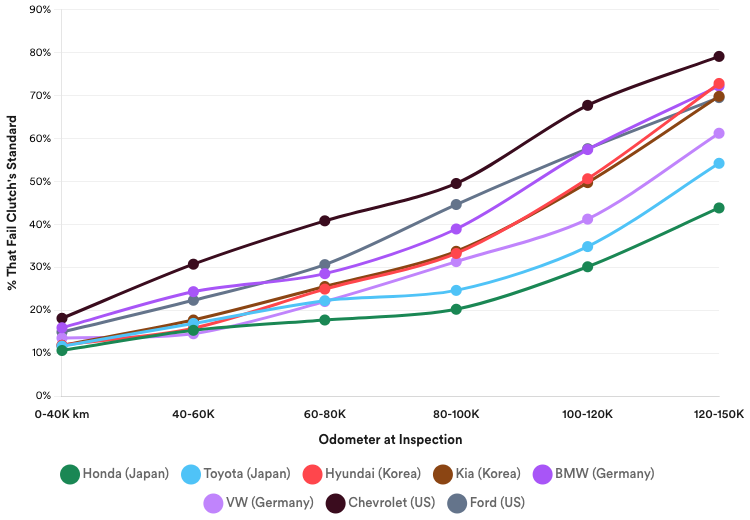
Inspection Failure Rate by Mileage and Brand
Source: Clutch Certified Reliability Report 2026
Exploring by brand further, a Honda consistently runs half the failure rate of a Chevrolet:
- At 25-37K miles: Honda only fails inspection 10.6 per cent of the time, whereas Chevrolet’s failure rate is 18.1 percent.
- At 62-75K miles: Honda only fails 30.1 per cent of the time, with Chevrolet at 67.7 percent.
- At 75-93K miles: Honda’s failure rate is 43.8 per cent, whereas Chevrolet is failing 79.1 per cent of the time.
Do EVs fail inspection more often than hybrids and gas vehicles? Only when Tesla is part of the equation.
EVs consistently run four to five points behind gas and hybrid vehicles in the first six years, leading with the highest inspection failure rates at 15.3 percent and 25.3 per cent. But when explored further, it’s not an EV technology issue; it’s a Tesla manufacturing issue.
EV quality, or reputation for faultiness, is informed by Tesla’s manufacturing issues. When compared to non-Tesla EVs, Teslas have the highest issue rate for brakes and suspension, electrical, body, interior, and HVAC.
Where Teslas hold up is core EV architecture: powertrain, safety and driver assist technology. Tesla’s poor physical performance drops down public perception of EVs as a whole, but non-Tesla EVs remain on par with both gas and hybrid quality.



Comments are closed.