
The aftermarket is expanding its economic footprint, outperforming inflation and increasingly serving as a domestically rooted manufacturing sector
Diamond Bar, Calif.—New economic impact data shows substantial three-year growth of the U.S. automotive aftermarket, as the industry continues to cement itself as a significant driver of the nation’s economy.
The study, commissioned by the Specialty Equipment Market Association (SEMA) and conducted by John Dunham & Associates based on 2026 U.S. economy data, offers compelling evidence that the specialty automotive aftermarket — and its domestic manufacturing sector in particular — is robust, resilient, and a major source of jobs, spending, and revenue, despite economic uncertainty, including pressures from inflation.
The study shows how the automotive aftermarket is outperforming inflation, expanding its economic footprint, and increasingly serving as a domestically rooted manufacturing sector, with growth spreading well beyond traditional automotive states, including:
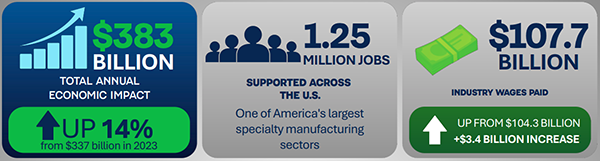
- Total annual economic impact grew to $383 billion (a +14% increase from $336.9 billion)
- Industry wages increased to $107.7 billion (up from $104.3 billion), reflecting continued investment in the workforce
- Total jobs are 1.25 million, with manufacturing employment an especially bright spot.
Manufacturing is a major source of growth for the automotive aftermarket. Direct specialty-equipment manufacturing employment increased 8% since 2023, with nearly 9,000 jobs added, bringing total direct manufacturing employment to more than 118,000.
Annual manufacturing wages increased by $3.9 billion to $13.2 billion, while direct manufacturing output rose by more than $29 billion to $82.7 billion.
“Three years after our first nationwide economic impact study, the data confirms that the specialty-equipment aftermarket remains a major American industry,” said SEMA CEO Mike Spagnola. “Our industry is still a big deal, contributing $383 billion to the U.S. economy and supporting 1.25 million jobs.
“This data should give policymakers a clear view of what is at stake and reinforce the importance of policies that enable American businesses to invest, hire, and manufacture domestically.”
The aftermarket’s 14% overall growth substantially exceeds the general inflation experienced during the period (8-9%), demonstrating real economic expansion, rather than merely price increases. The 2026 study shows fewer retail jobs, a product of how the federal government reclassified some electronic shopping and mail-order businesses (i.e. Amazon) from retail into business services, which fall outside this analysis.
However, because of retail sector rebalances, and because of increased productivity and inflation, the overall output impacts and wage impacts are generally larger than the prior study.
Gavin Knapp, SEMA’s Director of Market Research, stated, “It’s clear that the aftermarket industry remains a source of good-paying jobs and is rife with opportunity for small businesses to bring innovative products to market and play a part in sustaining this American economic driver of growth.
“It’s exciting to see this data, and when the 2026 SEMA Show opens on Nov. 3 in Las Vegas, we’ll do so knowing that our industry, and the automotive community it supports, continues to thrive.”
In addition to the national numbers, SEMA has an interactive map that provides the ability to drill-down to state-level, congressional and state legislative and Senate data.
Download the full report here.







Comments are closed.