
The EV market is becoming increasingly concentrated at the top of the price range, while non-luxury car share was just 2.3 percent as affordability pressures mount
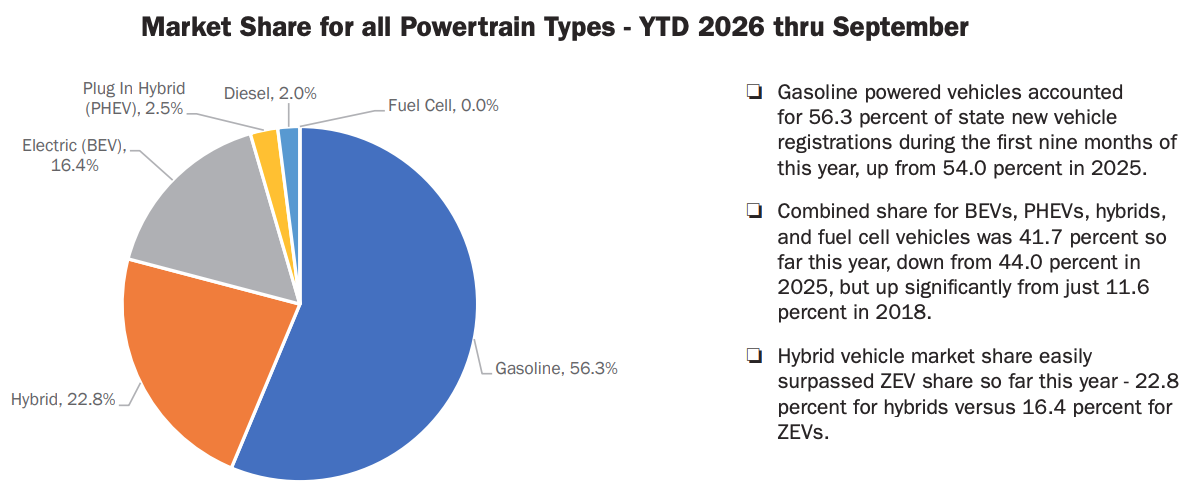
Sacramento, Calif.—Hybrid vehicles accounted for 22.8 percent of California’s new vehicle market through September, the highest share in the report’s data series and up from 19.5 percent for all of 2025, according to the California New Car Dealers Association’s Q3 2026 California Auto Outlook report.
The new vehicle market returned to growth in the third quarter, with registrations rising 3.9 percent compared to the third quarter of 2025. Here are more key highlights from the study.
Data sourced from Experian Automotive
• Hybrid share has now increased every quarter of 2026, climbing from 20.9 percent in the first quarter, to 23.2 percent in the second, to 24.1 percent in the third.
• Gas-powered vehicles remained the largest single segment of the market at 56.3 percent of registrations, up from 54.0 percent in 2025.
• Zero-emission vehicles (ZEV) registrations declined 26.1 percent through the first nine months of 2026 compared with a year earlier, falling to 215,467 units. California continues to lead the nation on electric vehicle adoption by a wide margin. The state’s ZEV share of 16.4 percent was more than two and a half times the U.S. figure of 6.2 percent, and California accounted for 28.9 percent of all ZEV registrations nationwide.
Luxury Segments Drive Remaining EV Demand
The EV market in California is becoming increasingly concentrated at the top of the price range. ZEV and plug-in hybrid combined share exceeded 42 percent in the luxury car segment and reached 59 percent in the small luxury SUV segment through the first nine months of the year.
In the non-luxury car segment, ZEV and PHEV combined share was just 2.3 percent. The gap underscores how affordability continues to shape powertrain decisions for most California households.
Model Rankings
• The Toyota Camry was the top-selling passenger car in California with 52,224 registrations, capturing 54.8 percent of the midsize and large car segment.
• The Honda Accord followed with 25,057 registrations (26.3 percent).
• The Honda Civic led small cars with 42,238 registrations, representing 32 percent of the segment.
• The Tesla Model Y remained California’s top-selling model overall with 86,099 registrations, accounting for 57.9 percent of the luxury compact SUV segment.
• The Honda CR-V led compact SUVs with 41,809 registrations at 19.4 percent. The Toyota RAV4 followed with 37,801 registrations at 17.5 percent.
• The Toyota Tacoma led compact and midsize pickups with 36,330 registrations at 51.5 percent.
• The Ford F-Series topped full-size pickups with 28,507 registrations at 28.3 percent, followed by the Chevrolet Silverado at 24,248 registrations.
Brand Performance Highlights
Nine of the top 30 selling brands recorded registration increases through September: Lucid, Volvo, Genesis, Chrysler, Kia, Toyota, BMW, Mercedes-Benz, and Lexus.
Toyota finished the first nine months as California’s top-selling brand with 19.2 percent market share, up from 17.5 percent a year earlier. Honda followed in second place at 11.0 percent of the market. Tesla ranked third at 9.3 percent, down from 9.9 percent.
Regional Markets
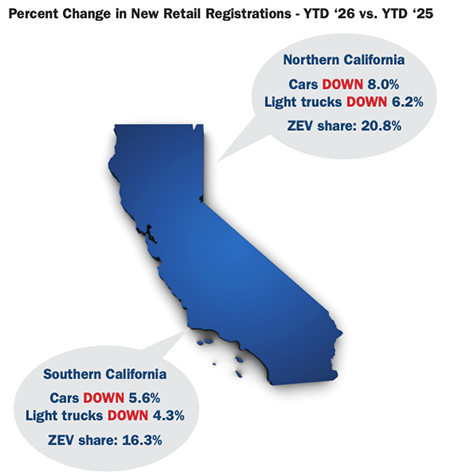
Northern California new retail registrations, which exclude fleet sales, fell 6.7 percent to 387,819 units through September. Passenger cars declined 8.0 percent, and light trucks fell 6.2 percent. ZEVs accounted for 20.8 percent of the Northern California market.
Southern California retail registrations declined 4.6 percent to 755,504 units through September. Passenger cars fell 5.6 percent, and light trucks declined 4.3 percent. ZEVs represented 16.3 percent of registrations.
Among individual markets, the San Francisco Bay Area posted the steepest decline at 9.2 percent, followed by Los Angeles and Orange counties at 5.9 percent and San Diego County at 5.9 percent.



Comments are closed.