
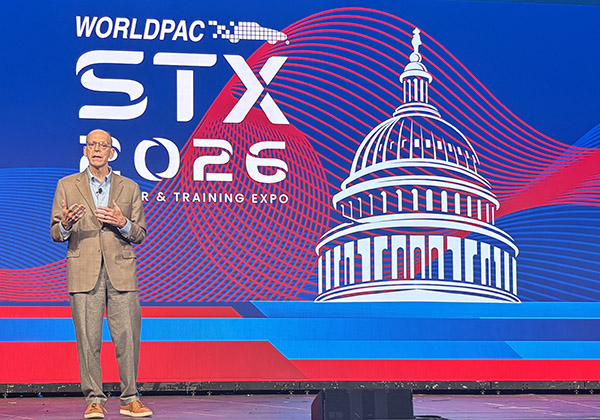
John Hamilton says the company is thriving with new investments and efficiencies on the “second anniversary” of its separation from Advance Auto Parts
National Harbor, Md.—While publicly traded automotive aftermarket parts providers are in the midst of Q3 reporting to their shareholders — Genuine Parts Company (Oct. 20), O’Reilly Automotive (Oct. 28), Advance Auto Parts (Nov. 5) — Worldpac, now a privately held by global investment firm Carlyle, recently gave its shop owner customers news on how the company is performing.
Worldpac President and CEO John Hamilton addressed over 2,500 aftermarket professionals during opening remarks at the biennial Worldpac Supplier & Training Expo (STX), which recently took place in August in National Harbor, Maryland. He noted that it was the “second anniversary” of its separation from Advance Auto Parts and that the company is thriving with investments and efficiencies.
“We want to be very good at the basics, and we want to bring the technology that’s available to everyone today — artificial intelligence — to use how we make parts available and deliver to you. That takes money. One of the beauties of not being part of Advance anymore is that they don’t take the money that we earn. We get to keep it to reinvest it in our own business.”
He outlined how Worldpac has recently invested capital to improve operations and customer value: inventory and automated warehouses to build efficiencies in moving parts from shelves to shops.
In the two years since Worldpac has been independent, he highlighted that inventory has increased $150 million. “That is an extraordinary investment. All that inventory, of course, is in our distribution centers and in our branches, and therefore, closer to you.”
He also noted that investment in capital expenditures has increased three times since 2024. “That’s what we are putting into our warehouses to improve the accuracy of our picks, improve the speed we get our work done so you can get it installed on vehicles — but also in some instances, to improve the vehicles that we get the parts put on.”
Worldpac now has 190,000 SKUs and makes between 40,000 and 50,000 deliveries a day from approximately 325 warehouses. “It’s an enormous challenge to figure out where you put 190,000 parts so that it can be available in such a short period of time.”
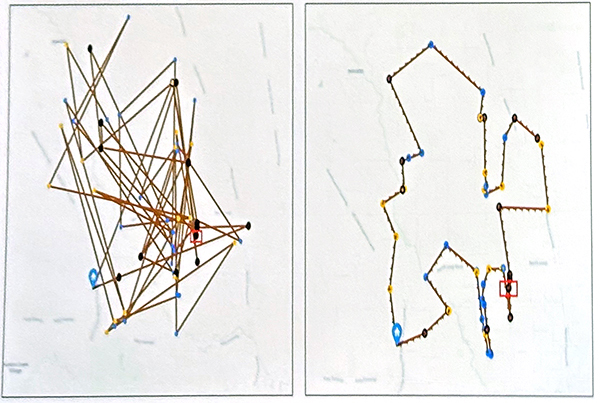
To meet those challenges, Worldpac has added 36 new or transformed branches, shortening time-to-delivery. Hamilton said he anticipates that number to increase to 80 by end of year. The company has also added more than 260 new routes and cut-offs to its existing branches.
Since the last STX in 2024, Worldpac has added 1,600 new products to its catalog, covering 27 vehicle brands and 410 unique part categories. The company has also deployed new technology to improve the accuracy of it parts-picking process. And to further improve timely parts deliveries, Worldpac is now using AI to “smooth out” delivery routes to ensure greater consistency of when the delivery will arrive after dispatch.
“So the SKUs that might have been in a different warehouse are now available to you, and we now have SKUs that weren’t available anywhere — now available to you.”
Hamilton added that Worldpac is also taking a closer examination of parts with high return rates and removing them from its catalog. When he first assumed his role, he said “bogus” parts returns were a concern. “One of the things that I kept hearing was, ‘I’m receiving a part that someone else has returned and it’s not what’s supposed to be in the box.'”
Approximately 19 percent of what Worldpac distributes comes back as a return, most often because the part wasn’t what was required for the repair, then it gets restocked. However, Hamilton said that sometimes when a box returns, it’s not the part that was initially delivered.
“Sometimes it’s even used. Of course, we check for that, but you don’t always catch it. There’s another area where to use artificial intelligence to examine that part and determine whether it’s really what it’s supposed to be, and it’s really in the condition it’s supposed to be in.”
Hamilton told shop owners they can expect improvements in that area so when they open the box, it’s the part they expect to be inside.
“We have 190,000 SKUs—190,000 different parts. And we make between 40,000 and 50,000 deliveries a day, and we do it out of 325 or so warehouses,” he reiterated. “It is an enormous challenge to figure out where you put 190,000 parts so that it can be available for you in such a short period of time. And that’s what our assortment strategy is about.”



Comments are closed.